Learning guide
Two of Wands: observation and reflective meaning
Two of Wands is one card in the 78-card Tarot Sidequest catalogue. Start with the image, then use the editorial synthesis as a possibility rather than a verdict.
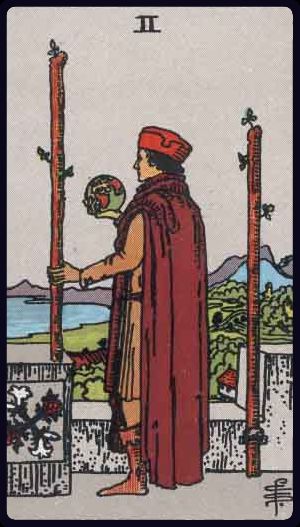
Card identity
Two of Wands combines the Two rank with the Suit of Wands. Sidequest uses that structure as an editorial reading aid, not as a claim that every deck or reader assigns the same meaning.
The visible image belongs to a Rider–Waite–Smith-derived production deck. A Marseille, Thoth, contemporary, or independently authored deck may use different titles, numbering, suit language, correspondences, and imagery. Read this page as one documented catalogue context, not as a universal dictionary entry.
Observe before you interpret
Set the card upright and give yourself a full minute before consulting guidance. Describe colour, posture, gaze, distance, weather, objects, and what appears to be changing. Separate observation (“a figure looks away”) from inference (“the figure refuses”). That small distinction keeps the image available for your own reading.
Notice growth, gesture, heat, pace, distance, and where energy is gathered, scattered, defended, or shared.
The current catalogue also records this deck-aware visual note: In common RWS imagery, a figure on a high wall holds a small globe and looks across water and land; one wand is held upright and another is fixed to the wall.
Sidequest editorial synthesis
The Two of Wands stands between established ground and a larger possibility. Planning matters here because it turns appetite for expansion into a direction you can assess and choose.
The catalogue’s working themes are planning, expanded horizon, chosen direction. Treat them as handles for inquiry. They summarize this edition’s prose; they do not exhaust the card or establish facts about your situation.
If the card is reversed
A reversal is an optional reading technique, not a second fixed definition. The current catalogue supplies this Sidequest reversal note: A reversal may show a safe vantage point becoming a hiding place, an outward plan that ignores home realities, or relief in choosing a smaller territory on purpose.
Test that note against the image and the spread position. You might ask whether the card’s energy is blocked, internal, delayed, excessive, resisted, or simply viewed from a less familiar angle. Keep the operator that produces useful reflection and discard the rest.
Put the card into practice
- Write three concrete details you can see before naming a theme.
- Read the spread position aloud and complete: “In this position, the card draws my attention to …”
- Write one interpretation that increases your agency and one alternative that challenges it.
- Choose one small observation or action you can revisit; do not turn the card into a prediction.
Use the card-study spread for a longer session, or start a private reading in the browser app. Saved reflections remain in that browser unless you export them.
Page record
- Author
- Tarot Sidequest editorial
- Editorial scope
- English learning material for reflective tarot practice. Historical claims are sourced; interpretive guidance is identified as Sidequest editorial synthesis.
- Last reviewed
- Evidence and sources
- Current 78-card runtime catalogue and canonical card identity
- The Pictorial Key to the Tarot
- LuciellaES deck source and rights profile